




Origins and context
Vlad the Impaler (Vlad Țepeș, Vlad III), known in the sources of the time as “Dracula” — meaning “son of Dracul,” after his father Vlad II Dracul — was most likely born in 1431, in Transylvania (often cited as Sighișoara; other traditions mention Târgoviște). He came from the Drăculești branch of the Basarab dynasty, heirs to a throne perpetually at a crossroads: Wallachia was wedged between the Kingdom of Hungary and the Ottoman Empire, where shifting alliances, border wars, and boyar revolts were almost routine politics.
Vlad II Dracul, his father, had entered the Order of the Dragon — a chivalric brotherhood with an anti-Ottoman program — which brought him prestige in the Christian world and pressure from every direction. This double loyalty (to Hungary and, when the balance required, to the Porte) shaped Vlad III’s understanding of power from childhood: you survive by moving quickly and striking decisively.
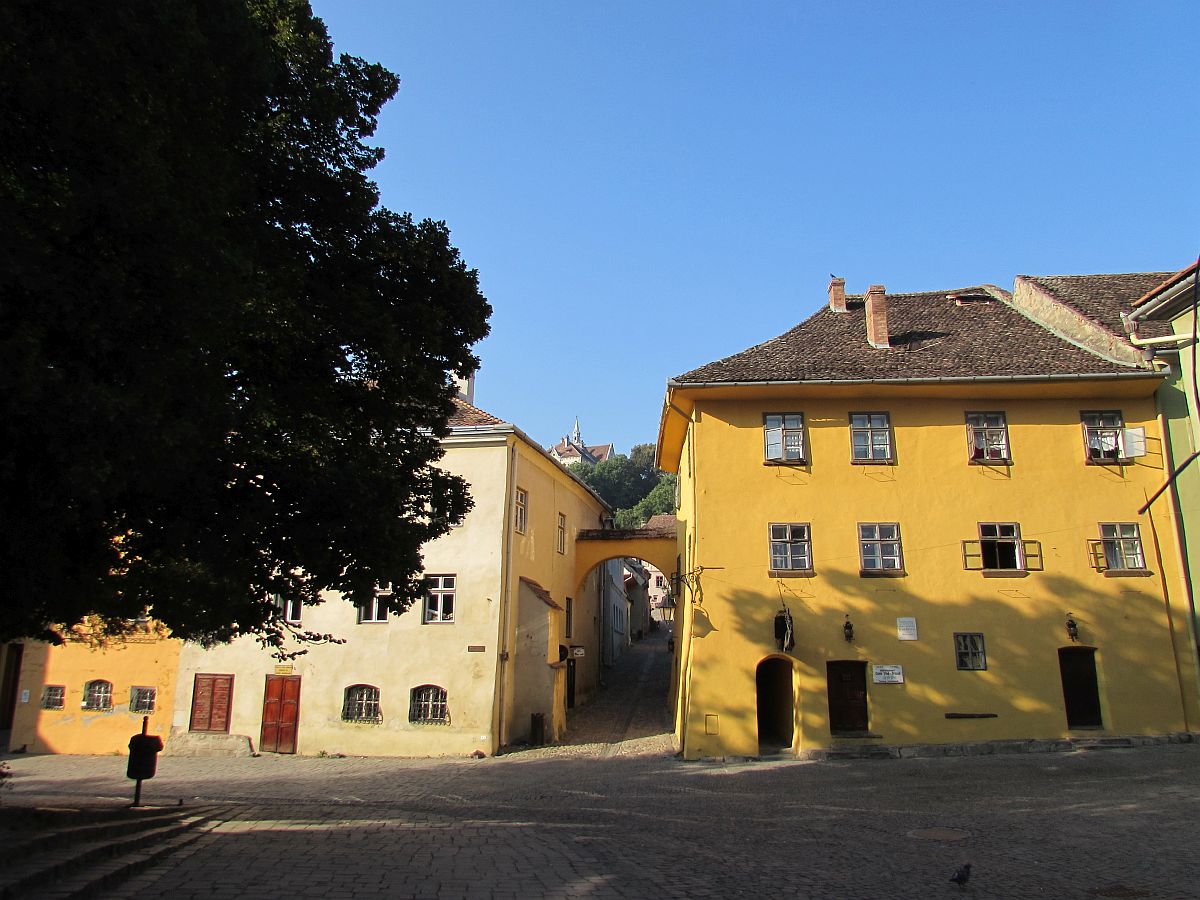
The house from Sighișoara, Romania, of Vlad Dracul, father of Vlad the Impaler
Transylvanian childhood and the “school” of Saxon towns
In his early years, Vlad knew the Transylvanian urban milieu: guilds, city walls, Saxon trade, and the mutual distrust between local elites and Romanian nobles across the Carpathians. Here he saw how taxes are negotiated, debts collected, and a city gate guarded — small things that would later feed his obsession with discipline and the fisc.
A fifteenth-century princely education included horsemanship, weapons training, hunting, and chancery skills: reading letters in Latin or Church Slavonic, the meaning of seals, the rhetoric of promises and oaths. Around Vlad, the idea of “law” was always paired with the idea of “force.”
The road to Târgoviște and first political lessons
With the consolidation of Vlad II’s reign (1436–1442, 1443–1447), the family moved to Wallachia. The court at Târgoviște was cosmopolitan: Hungarian envoys, Ottoman emissaries, Balkan merchants, Latin and Orthodox clergy, boyars hungry for influence. Here the young Vlad learned that the throne was not a “linear inheritance,” but a seat you occupy only as long as you can keep the nobility and the borders in check.
A “hostage” at the Porte: education, pressure, and survival
In 1442, amid tensions between Buda, the Wallachian court, and the Porte, Vlad and his younger brother Radu (the future “the Handsome”) were sent as political guarantees to the sultan’s court — at Edirne (Adrianople). In that era, the status of “hostage” was both peril and opportunity: young princes received an elite education (Turkish language, campaign strategy, Ottoman administration) but lived under the threat of punishment should their father misstep with the sultan.
For Vlad, the years at the Porte meant:
- Initiation into frontier warfare: swift raids, supply lines, use of terrain, the psychology of fear.
- Understanding imperial mechanisms: how tribute is collected, how vassals are kept close, how religion is used as a political tool.
- Knowing the rival: language, customs, the janissaries’ tactics — a “manual” he would later turn against them.
This period sharpened his powers of observation and his cynicism: promises are reversible, and loyalty is bought or broken.
The blow of 1447: a trauma that breeds vendetta
The crisis of 1447 was the founding moment for the future Țepeș. Vlad II Dracul was deposed and killed amid struggles among boyar factions and the influence of John Hunyadi; Vlad’s elder brother, Mircea, was captured and cruelly executed. For the young Vlad, the news meant not only the loss of father and brother, but also the realization of internal treachery: when they feel strong, the boyars can topple a ruler as quickly as they raised him.
From then on, the idea of exemplary punishment became state policy in waiting — not yet unleashed, but already formed. He understood that to hold such a vulnerable throne, you must strike where it is least expected: at the impunity of the local elites.
Between empires and refuges: Moldavia, Transylvania, Hungary
Driven from the Wallachian stage, Vlad shuttled between courts that could offer protection and support: Moldavia (ruled by Bogdan II, with Stephen the Great later entering the scene), Transylvania, and indirectly Buda. These years of political wandering were an intensive diplomatic residency:
- he learned to sift genuine promises from convenient ones,
- he forged ties with nobles, captains, and officials who could be useful “when the time came,”
- he watched closely what was happening south of the Danube, where Sultan Mehmed II consolidated his ambitions after the fall of Constantinople (1453).
At the same time, Vlad began to build a reputation as a determined pretender, capable of returning, negotiating, changing patrons temporarily, yet never losing sight of his target: Târgoviște.
At the threshold of the throne: 1448
In the autumn of 1448, the regional context wobbled again: great armies were exhausted by campaigns and borders lay exposed. Vlad seized the power vacuum to enter Wallachia with Ottoman support — a tactical move, not an eternal attachment. In his view, the throne was a tool, not the ultimate goal: the goal was to dam the internal chaos and impose an order that could not be defied.
Though this first attempt was short-lived, it marked the end of his apprenticeship and the start of his political career proper. Vlad tested the boyars’ reactions, the speed of rival mobilization, and the limits of external backing. From this moment on, every step would be more calculated, more unyielding, and more spectacular in effect.
What youth left in the future ruler
By the time he reached the throne, Vlad’s portrait was already drawn:
- A product of frontiers: raised among Saxon walls, Wallachian-Moldavian courts, and the sultan’s palace, he understood that Wallachia could not survive without fiscal, military, and political discipline.
- A brutal realist: the loss of father and brother convinced him that tolerance for treachery destroys the state more surely than an invasion.
- A strategist of fear: he grasped that in a space with limited resources and rapacious neighbors, fear is a more stable currency than the love of subjects or the goodwill of the boyars.
- An opportunistic diplomat (in the sense of his age): able to take support wherever it could be found and turn it to his advantage at the right moment.
Taken together, Vlad the Impaler’s youth is not a prelude but the recipe for a style of governance that would both astonish and horrify Europe. When he mounted the throne, he did not start from zero: he arrived with a manual written during years of captivity, exile, flight, and observation — a manual of power applied without hesitation.
Leave a Reply