




Description
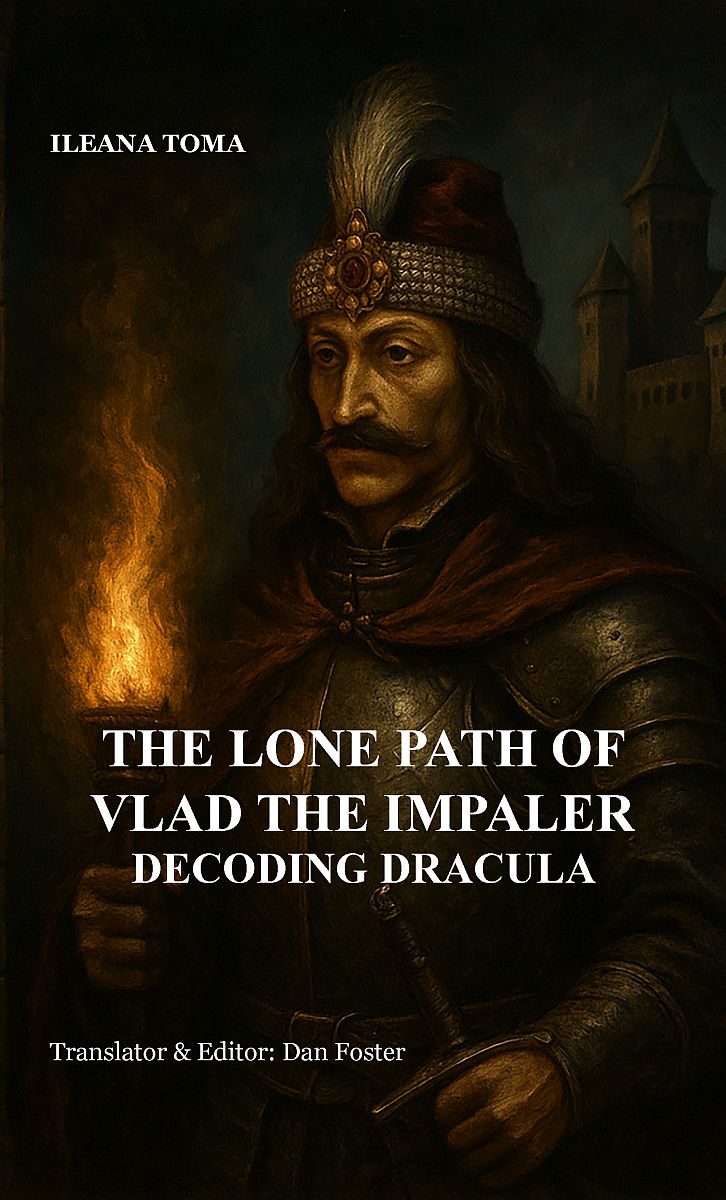
A gripping, human portrait of the most misunderstood ruler in European history
by Ileana Toma
Step beyond the vampire myths into the real, pulsing heart of 15th-century Wallachia. The Lone Path of Vlad the Impaler blends intimate storytelling with sweeping history—following Vlad Drăculea through captivity, love, power, betrayal, and the terrible choices demanded by a world at war.
Why readers will love it
- Myth vs. man: Dispels the vampire legend to reveal the strategist, son, prisoner, ruler, and lover behind the nickname.
- Cinematic history: Battles, intrigues, and courtly games of power unfold with page-turning momentum.
- A tender core: From “Stanca was the light of my life” to “Notes from Prison,” the novel centers the feelings behind the iron will.
- Richly researched: Ottoman marches, Bucharest markets, fortresses on the Danube—every scene feels lived-in and true.
What it’s about (in a nutshell)
When fire beacons blaze on Wallachian hills, they signal more than invasion—they light the path of a ruler forged by captivity and conflict. From a youth spent as a hostage in Anatolia to a throne won and defended against overwhelming odds, Vlad’s story is one of brutal calculus and fragile hope: of councils and conspiracies, of merchants and monarchs, of love that steadies a storm-tossed life. This is not a monster’s tale; it’s the journey of a human being walking alone against the tide of history.
Inside the book
A few standout chapters:
- They Told Me Vlad Is Dying – dread rises with the Sultan’s solemn march.
- The Return – a prince comes home to a country on edge.
- Beginning of Reign – power claimed, and a price paid.
- The Merchants and the Noblemen – gold, favors, and the fragile balance of order.
- European Gathering – courts whisper while armies gather.
- The Turks Are Coming! – the Danube burns, and fear gets a name.
- Notes from Prison – when steel cannot protect, memory does.
- 1476. So It Was Meant To Be – a destiny met without flinching.
- The Final Journey – the legend gives way to the man.
Who it’s for
Readers of historical fiction and political epics who loved The Pillars of the Earth, Wolf Hall, or The Name of the Rose—and anyone curious what really lay behind the “Impaler” epithet.
About the author
Ileana Toma brings a keen historian’s eye and a novelist’s heart to a pivotal era for Eastern Europe, crafting a narrative that is as emotionally resonant as it is meticulously grounded.
Formats & purchase
- eBook (Kindle) – Instant delivery
- Paperback – Perfect for book clubs
👉 Buy now — Secure checkout. Instant eBook access.
Early reader reactions
- “A fierce, lyrical portrait that finally lets Vlad be human.”
- “History that reads like a thriller—couldn’t put it down.”
- “So vivid I smelled the smoke on the Danube.”
FAQ
Is this a horror book?
No. It dismantles the vampire myth and focuses on the historical Vlad Drăculea—his choices, allies, enemies, and inner life.
How accurate is the history?
The novel draws on chronicles, regional folklore, and period details to ground each scene, while telling a propulsive, character-driven story.
Is there violence?
Yes—depicted responsibly and never for spectacle, reflecting the realities of 15th-century warfare and justice.
Buy the Book
Read a Free Sample
History made human. Legend made true.
Author: Ileana Toma
Translator and editor: Dănuț Păduraru
The novel begins with Vlad being held hostage by the Turks from the age of 12 (until 18), followed by his brief initial reign. After officially taking the throne in 1456, it portrays his revolt against Ottoman suzerainty when he attacked Turkish settlements along the Danube. He then confronted the invasion led by Mehmed II, forcing the latter to abandon plans to turn Wallachia into an Ottoman province. The Ottoman Empire never extended its borders beyond the Danube again. Vlad was subsequently detained for 17 years by the King of Hungary, whose political goals clashed with Vlad’s actions. His final reign, in 1476, ends in battle, where he is killed by the Turks.
Readers are offered a vivid depiction of the era and the personality of Vlad, nicknamed “The Impaler,” through characteristic scenes in the book, such as:
• Justice scenes (“Let Them Be Caught and Executed,” “Nicanor’s Cup”);
• Battle scenes (“The Trap,” “General Terror,” “At Srebrenica”);
• A romantic scene (“You Still Owe Me, Mistress”);
• A satirical scene (“European Encounter”);
• A significant historical moment (“Of Sadness, Not of Grief”).
Confession
During my childhood, my parents’ house was filled with music. Being one of four siblings, debates about the qualities of great composers and favorite pieces were common. I loved Beethoven’s symphonic poem “Egmont,” while my brother preferred Bizet’s “L’Arlésienne.” In defending these preferences, I learned the story of Egmont, a Dutch count and general who led a revolt against Spanish rule and was executed in 1567. Similarly, from Rossini’s overture to “William Tell,” I discovered the legend of Switzerland’s hero. Such noble portrayals—kudos to the creators of culture from great nations who honor the virtues of smaller ones!
Belonging to a small nation can be difficult, especially when forced to leave your homeland due to the decisions of global powers during conferences and summits. Nor is it easier to witness the defamation of one’s ancestors by “creators” of literary or cinematic works. Why should Vlad the Impaler be considered less significant than Egmont, or Constantin Brâncoveanu less heroic than William Tell? How can one accept baseless tales of vampires (erroneously bearing Vlad’s name) or false judgments about the policies of these historical figures? In the 21st century, I ask only for the dignity of these forebears to be upheld, recognizing their sacrifices for faith and country.
Message to the Reader
Many have heard of this Romanian ruler through horror films about vampires, which, aside from their absurdity, reflect indifference to historical truth and even disdain for the past of smaller nations. Vlad the Impaler, ruler of Wallachia, used the justice methods of his era—impalement was not his invention. Yet, he was mourned when corruption and injustice plagued society. Poet Mihai Eminescu writes:
“Oh, Vlad, Lord Impaler, why don’t you come back,
To split them into two groups, madmen and knaves,
And in two vast dungeons, by force to gather them,
And set fire to the madhouse and the prison alike!”
This novel, seemingly a tale of adventure, is in fact a vivid chronicle of a solitary hero’s tragic struggle against external and internal evils afflicting his homeland. Thus, readers are urged to reject the irresponsible denigration of a life and an era to which we may owe more than we realize.
Amazon: https://www.amazon.com/Lone-Path-Vlad-Impaler-Decoding-ebook/dp/B0FH4BYGZN/
Reviews
There are no reviews yet.