
Vlad the Impaler between Downfall and End (1462–1476)
1) 1462: Fall from the Throne and a “War of Nerves” with the Ottoman Empire
The peak of Vlad the Impaler’s clash with Sultan Mehmed II was the 1462 campaign, marked by the night attack at Târgoviște. Although the maneuver shook Ottoman morale, the balance of resources still favored the Porte. Mehmed installed Vlad’s younger brother, Radu the Fair, as an Ottoman-backed ruler. Lacking sufficient boyar support and with the country exhausted, Vlad was deposed and crossed the mountains into Transylvania, seeking support from the King of Hungary, Matthias Corvinus.
2) 1462–1466: Arrest at Brașov and Captivity in Hungary
In late autumn 1462, Vlad was arrested on Matthias’s orders, likely at Brașov. The official motive was a set of letters attributed to Vlad that appeared to show he had negotiated with the sultan; many historians consider them propagandistic forgeries, politically convenient for Matthias to justify a shift in alliance.
This was followed by a period of captivity between Visegrád and Buda. His treatment varied over time: initially harsh (imprisonment), later more relaxed (house arrest/“forced residence”) as the geopolitical context changed. During this period, Vlad cultivated the image of a useful anti-Ottoman prince and maintained contacts with Transylvanian circles and the Hungarian court.
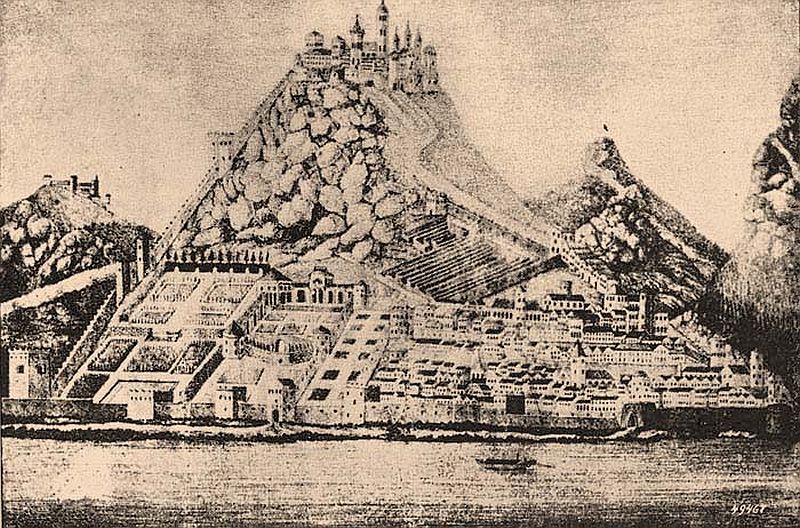
The Renaissance palaces of Matthias Corvinus’ summer residence at Visegrád, where Vlad the Impaler was imprisoned (engraving from the 1480s)
Personal life in captivity. During this time (most likely after 1465), Vlad formally converted to Catholicism, a political gesture meant to improve his position in the Kingdom of Hungary. He married a noblewoman from the Szilágyi family circle (a relative of Matthias Corvinus, named in some sources Ilona/Justina Szilágyi). The exact details (name, precise kinship) remain disputed among scholars.
3) 1466–1475: From Useful Prisoner to Potential Military Ally
As Ottoman pressure mounted on the Danube and Ștefan cel Mare of Moldavia (Stephen the Great) entered into direct conflict with the Porte (the victory at Vaslui, January 1475), Vlad again became a strategic option for Buda: restoring an anti-Ottoman rule in Wallachia. In 1474–1475, his detention regime eased significantly; Vlad took part in military preparations and received support for a return to the throne.
4) 1476: The Restoration Campaign
In the autumn of 1476, a concerted campaign unfolded: Hungarian forces, Moldavian troops led by Stephen the Great, and Transylvanian contingents entered Wallachia against Basarab Laiotă the Old, a vacillating ruler backed by the Ottomans.
The campaign succeeded: Târgoviște was occupied, Basarab retreated, and Vlad the Impaler was reinstalled as prince (his third and very brief reign). However, the restoration critically depended on the presence of allied forces; as soon as the bulk of the armies withdrew, Basarab returned with Ottoman support.
5) The Death of Vlad the Impaler: Place, Date, and Versions
The end came at the close of 1476 (most likely in December), during an ambush south of Bucharest, in the Codrii Vlăsiei area (frequent hypotheses: around Snagov–Comana).
There are several versions:
- The “ambush” version: Vlad, with a small escort, was caught between Ottoman forces and boyar partisans of Basarab; he fell in battle.
- The “camp confusion” version: amid the fight, he was allegedly killed by mistake by his own men, due to confusion over dress/identifying signs.
- The fate of the head: accounts converge that his head was cut off, sent to Constantinople to Sultan Mehmed II, and displayed on a stake as proof of his death.
Burial place remains controversial. Popular tradition points to Snagov Monastery, but modern research has also proposed Comana Monastery (founded by Vlad), which would be consistent with the area where he fell. To this day, there is no definitive archaeological consensus.
6) Why Did He Lose the Throne Again?
- Resource inferiority: Wallachia was a strategic corridor between two great powers; without allied armies present, an “anti-Ottoman” ruler was vulnerable.
- Boyar fragmentation: part of the local elite backed “compromise” rulers aligned with the Porte.
- Reprisals and internal memory: his policy of harsh repression in 1456–1462 won both discipline and enemies.
- Continual external pressure: Basarab’s swift return with Ottoman support decided the fate of the short 1476 reign.
7) Image, Myth, and Sources
During his captivity and after his death, Vlad the Impaler’s image “split”:
- In German pamphlets and some humanist chronicles, he appears as a tyrannical monster, with hyperbolic narratives;
- In Slavic/Russian chronicles and local tradition, he often appears as a relentless justiciar, defender of order and the Christian frontier;
- European posterity “fused” these strands, and his figure was later contaminated by the (fictional) Dracula mythology, which complicated public perception.
8) Essential Chronological Markers (1462–1476)
- June 1462 – Ottoman campaign; the night attack at Târgoviște; subsequent withdrawal;
- November 1462 – arrest at Brașov; beginning of captivity in Hungary;
- c. 1463–1474/75 – varying detention between Visegrád and Buda; formal conversion; political marriage;
- Autumn 1476 – campaign with Hungarian–Moldavian support; Vlad returns to the throne;
- December 1476 – death in battle/ambush; head sent to Constantinople.
Conclusion
The years 1462–1476 formed a transition for Vlad the Impaler: from warrior-prince confronting the Ottoman Empire head-on, to a bargainable prisoner, and then to a reactivated strategic pawn when the regional context demanded it. His return to the throne—swift and dramatic—ended according to the geopolitical logic of the 15th century: without sustained resources and permanent alliances, one loses. His death—spectacular and still debated in its details—fixed Țepeș forever on the boundary between history and legend.