




Vlad the Impaler (Vlad Țepeș, or Vlad III), son of Vlad Dracul and a member of the Drăculești branch, ruled Wallachia three times: briefly in 1448, then during his peak years 1456–1462, and again—ephemerally—in 1476. His reputation—somewhere between relentless justiciar and bloodthirsty prince—took shape at the crossroads of an authoritarian domestic policy, hard campaigns against the Ottoman Empire, and a propaganda war waged mainly by Transylvanian Saxons and rival courts.
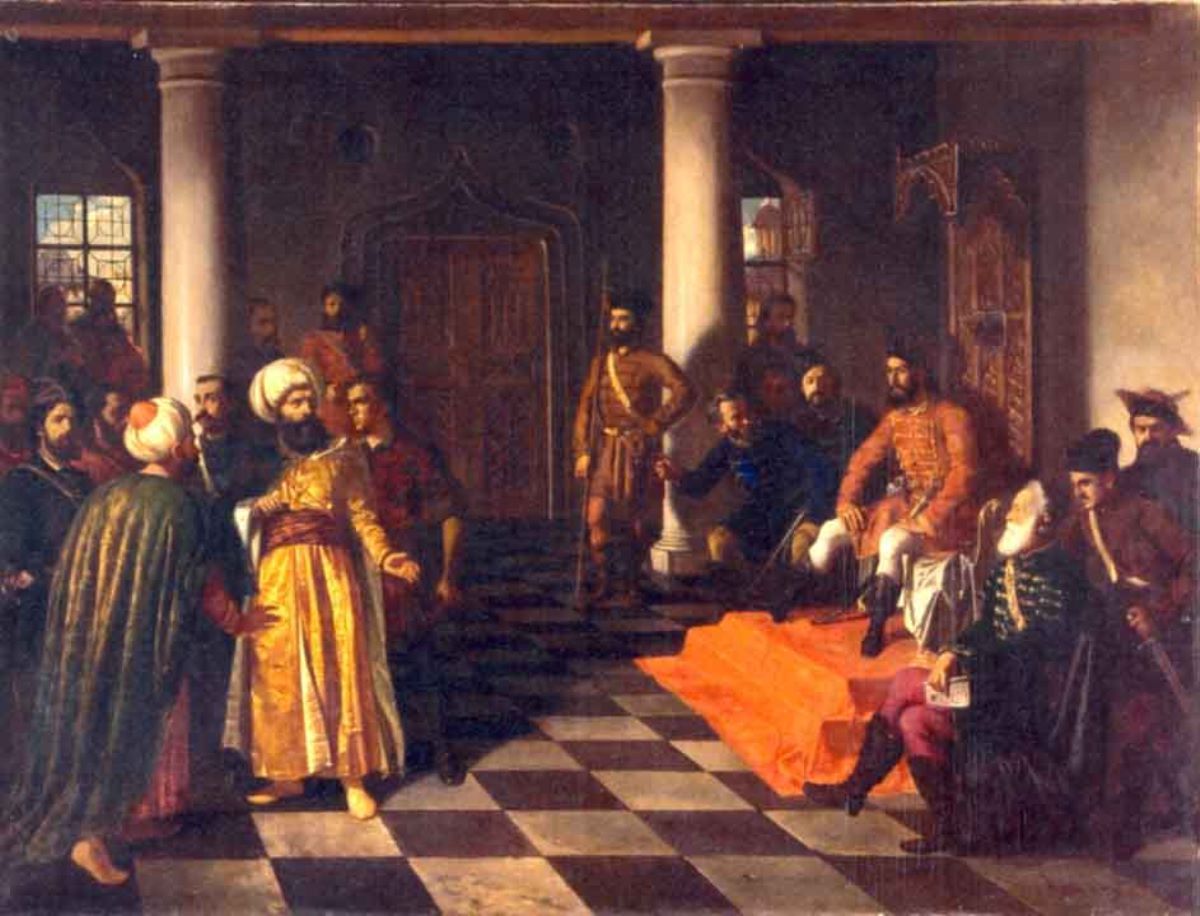
Vlad the Impaler and the Turkish Envoys. Artist: Theodor Aman. Credit: National Museum of Art of Romania. Public domain
The road to the throne
In the first half of the 15th century, Wallachia stood between pressure from the Ottoman Porte and the ambitions of the Kingdom of Hungary. Vlad the Impaler spent part of his youth as an Ottoman hostage, an experience that shaped both his hostility toward the Porte and his understanding of the mechanics of power. His first accession (1448) came amid the great Balkan clashes, but it was short-lived: lacking a solid political base, he was toppled by dynastic rivals.
Consolidating power (1456–1462)
Returning as ruler in 1456, Vlad the Impaler moved quickly to reassert internal control. He struck hard at political opponents among the great boyars, curbing their autonomy and punishing plots without hesitation. Purging the state apparatus—through exemplary executions, confiscations, and relocations—aimed to break the cycle of rapid turnovers typical of Wallachian rule. In parallel, he promoted middle and lesser boyars, tying their advancement to loyalty and fulfillment of military obligations.
Economically, he tightened princely control over trade routes. His conflict with Saxon merchants from Brașov and Sibiu—stoked by violations of privileges and by their harboring of his opponents—spiraled into reprisals: market towns and suburbs were raided, and merchants accused of fraud were punished severely. These measures sought to discipline the flow of goods and create more predictable taxation in favor of the princely treasury.
Law and order—uncompromising “justice”
Vlad the Impaler’s domestic policy centered on order. Theft, corruption, tax evasion, official abuse, and treason were punished harshly, including by impalement—a medieval judicial practice, brutal yet intended to deter lawbreaking. Numerous anecdotes grew around these punishments—such as the golden cup left by a public fountain that no one dared steal—reflecting less the literal facts than the cultivated image of a ruler who delivered “justice” without hesitation.
Administratively, Țepeș strengthened princely residences (Târgoviște remained the political capital), fortified strategic points such as Poenari, and developed the Princely Court at Bucharest. The earliest known documentary attestation of Bucharest dates to 1459, from Vlad’s chancellery—evidence that the town was becoming increasingly important in governance.
Foreign relations: between Hungary, Moldavia, and the Ottoman Porte
On a foundation of shared interests with Hungary’s King Matthias Corvinus and an alliance with Stephen of Moldavia (whom he helped to the throne in 1457), Vlad the Impaler shaped his external policy. Initially, he paid tribute to the Porte, as was customary; once consolidated at home, he stopped payment and launched punitive raids against Ottoman-administered districts (raias) and crossing corridors south of the Danube. These were sudden winter or night operations aimed at wrecking logistics and discouraging Ottoman incursions.
The 1462 campaign and the “Night Attack”
The conflict escalated in 1462, when Sultan Mehmed II, conqueror of Constantinople, led a major expedition against Wallachia. Vlad answered with harassment tactics, scorched earth, population movements that fostered epidemics, and sabotage. The key moment was the June 1462 night attack, when he tried to strike directly at the Ottoman camp and eliminate the sultan. Though he missed his primary target, he inflicted heavy losses and spread panic. The “forest of stakes” at Târgoviște—Ottoman prisoners’ corpses displayed across the fields as a warning—became the emblematic image of his rule in contemporary sources.
Even so, the disparity in resources forced him northward. The support Matthias Corvinus had promised was slow to materialize, and political intrigue did the rest: in autumn 1462, Vlad the Impaler was arrested by the Hungarian king, officially on charges of negotiating with the Ottomans. Years of captivity followed (with varying degrees of freedom) around Buda and Vienna, during which hostile propaganda—especially German pamphlets and woodcuts—cemented his image as a “butcher-voivode.”
The 1476 return and his end
A shifting strategic context—the Porte’s continual pressure and Hungary’s need for a loyal ruler south of the Carpathians—opened Vlad’s path back to the throne in 1476, with significant support from Stephen the Great. The reign was extremely short: caught between boyar factions and Ottoman counterattacks, Vlad died at the end of that year in a battle near Bucharest. His burial place remains disputed (Snagov and Comana are among the hypotheses), a mystery that has fueled centuries of local mythmaking.
Image, propaganda, and legacy
Few medieval princes have had such a dense literary and visual afterlife. In the West, German pamphlets and engravings turned him into a punitive monster, reflecting both horror at his punishments and the era’s commercial and political conflicts. In Eastern sources, Slavic chronicles portrayed him as a defender of order and justice, a ruler cutting mercilessly into corruption and treason. From this clash of narratives emerged an ambivalent figure, one that modernity would often—improperly—confuse with the vampire myth from Bram Stoker’s novel.
Beyond legend, Vlad the Impaler’s political record in Wallachia looks like this:
- Short-term internal stabilization by breaking hostile boyar networks and centralizing princely authority.
- Fiscal discipline and control of trade routes, at the cost of deteriorating relations with Transylvanian Saxon communities.
- Asymmetric military resistance against the Ottoman Empire, capable of delaying—but not eliminating—the pressure of a great power.
- Crafting the image of a “ruler of justice,” achieved through extreme punishments and swift justice that reduced crime yet left an enduring imprint of terror.
Conclusion
Vlad the Impaler’s reigns fit the harsh logic of the 15th-century Balkans: fragile sovereignties between empires, domestic politics where survival demanded ruthless authority, and an external game of shifting alliances. If legend has hyperbolized his cruelty, history records above all a principality held with an iron hand, for which order and autonomy—however relative—were paramount. In this light, Vlad the Impaler remains one of Wallachia’s most effective yet most controversial rulers.
Leave a Reply